In this area
The Milan issue
Duomo & Centro Storico, Milan: marble, mosaics and the city performing itself
A walk through Milan’s most concentrated quarter, where the cathedral spires, the Galleria’s glass dome and La Scala sit a few minutes apart, and every step comes with a premium.

By Silvia BrambillaMilan by its showrooms and studios

Milan begins here for most visitors, at the edge of Piazza del Duomo, where 135 marble spires rise above the square and the city seems to have decided, with characteristic efficiency, to put its greatest hits within a few hundred metres of one another. The cathedral fronts the piazza like a white stone mountain; the Galleria Vittorio Emanuele II slips off one corner under its glass dome; and La Scala waits just beyond, as if opera were a natural extension of a shopping arcade. It is a place of scale and choreography, of crowds and commerce, of Milan showing its hand and knowing exactly what it is doing.
What Duomo & Centro Storico is known for
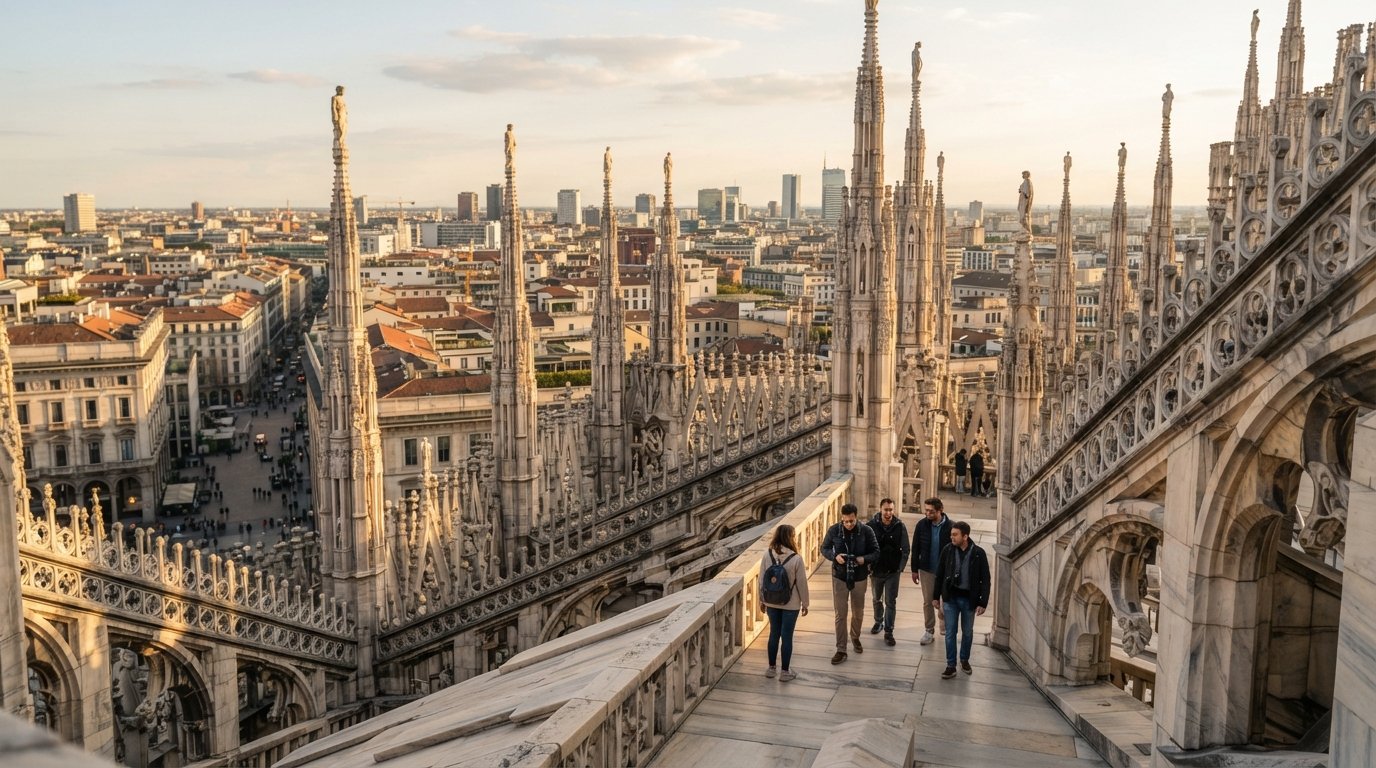
The first thing to understand is that this is not a neighbourhood in the cosy, residential sense. It is a stage set, but one built from the city’s most serious materials: marble, iron, fresco, and money. The Duomo di Milano is the reason the square exists at all, a Gothic cathedral bristling with more than 3,000 statues and finished, in the city’s own patient way, over nearly six centuries. Its rooftop terraces are the real revelation. Up there, you walk among the flying buttresses and spires with the whole city below and, on a clear day, the Alps in the distance. It is the one moment in the area when the noise drops away and Milan becomes legible.
Off the piazza’s north corner, the Galleria Vittorio Emanuele II gives the square its other great signature: a cross-shaped iron-and-glass arcade inaugurated in 1877 and designed by Giuseppe Mengoni. Under the 47-metre dome, the light softens and turns gold, and the floor mosaics — especially the Turin bull — have been polished by a century of visitors spinning their heel for luck. It is one of those Milan rituals that sounds quaint until you watch the queue form around the worn mosaic and realise the city has made a little theatre of superstition.
A short walk north and you reach Teatro alla Scala, which is still one of the most storied opera houses on earth, and not merely because its name is famous. The museum there is a compact lesson in the city’s taste for memory, costume and performance. Then, tucked behind the grander attractions, Piazza dei Mercanti and the 13th-century Palazzo della Ragione offer a different Milan entirely: medieval, hushed, and almost suspiciously calm. Most people hurry between the cathedral and the arcade and never notice how quickly the volume falls one street back. That is the trick of the Centro Storico. It performs at full volume on the main stage, then lets you slip behind the curtain.
Plan your Milan trip
Live prices from our booking partners.
Guests & rooms
Free cancellation on many rooms. We may earn a commission when you book.
Where to eat & drink
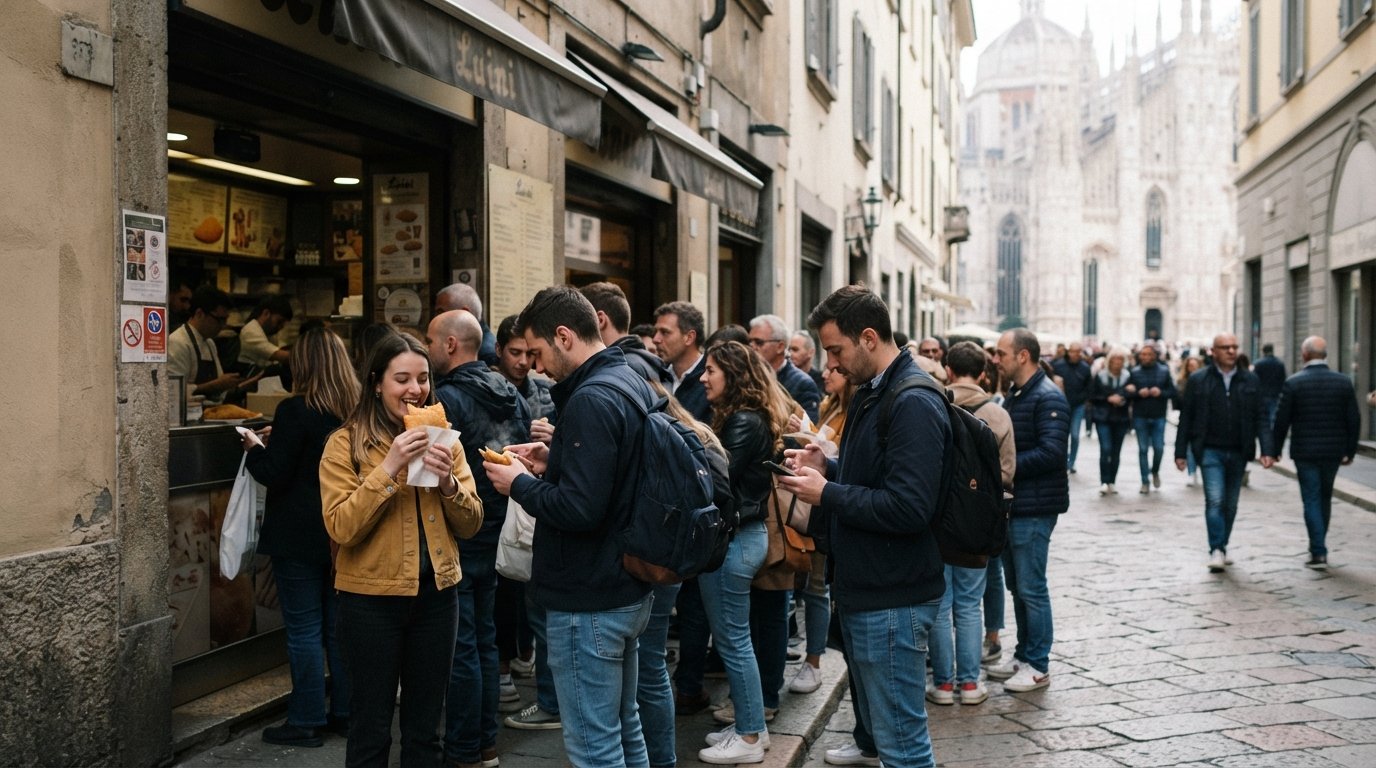
The dining lesson here is simple: know where the tourist tax ends and the real Milan begins. The best lunch may be the least ceremonious one. At Luini on Via Santa Radegonda 16, the queue is part of the ritual. This family panzerotti stand has been serving molten tomato-and-mozzarella fried pockets since 1949, and it does not need to pretend to be anything else. You eat standing up, probably too quickly, with the filling threatening to escape at the first bite, and you pay only a few euros for the privilege. In a district where many places are selling the view, Luini is selling a snack that people actually line up for.
A block from the piazza, Peck on Via Spadari 9 has been Milan’s grand food hall since 1883, and it still feels like the sort of place where a city with a taste for precision comes to stock its pantry. There are cured meats, 250-plus cheeses, thousands of wines, and a bar for a quick plate if you want to sit down without surrendering the afternoon. Peck is not cheap, and it knows it. But it earns the confidence with the sheer seriousness of the selection.
For the canonical Milanese meal, Trattoria Milanese on Via Santa Marta 11 has been doing the work since 1933: risotto alla Milanese, ossobuco, cotoletta. The room is not trying to be modern, which is part of its charm. It is the kind of place where the city’s culinary memory is allowed to remain intact, a little browned at the edges, and all the better for it.
At the polished end of the spectrum, Cracco in Galleria places a Michelin-starred restaurant inside the arcade itself, Carlo Cracco’s four-floor space operating with the sort of confidence that only a central Milan address can support. If you want the square beneath you rather than beside you, Spazio Niko Romito sits on an upper floor of Il Mercato del Duomo, and Giacomo Arengario, on the terrace of the Museo del Novecento, gives you one of the best Duomo views in the city with your meal. For coffee and cake, Marchesi 1824 — Prada-owned, historic, and beautifully boxed — is the jewel-box counter inside the Galleria. It is the right stop if you want your espresso served with a little old-world polish and no need to shout over the crowd.
Going out
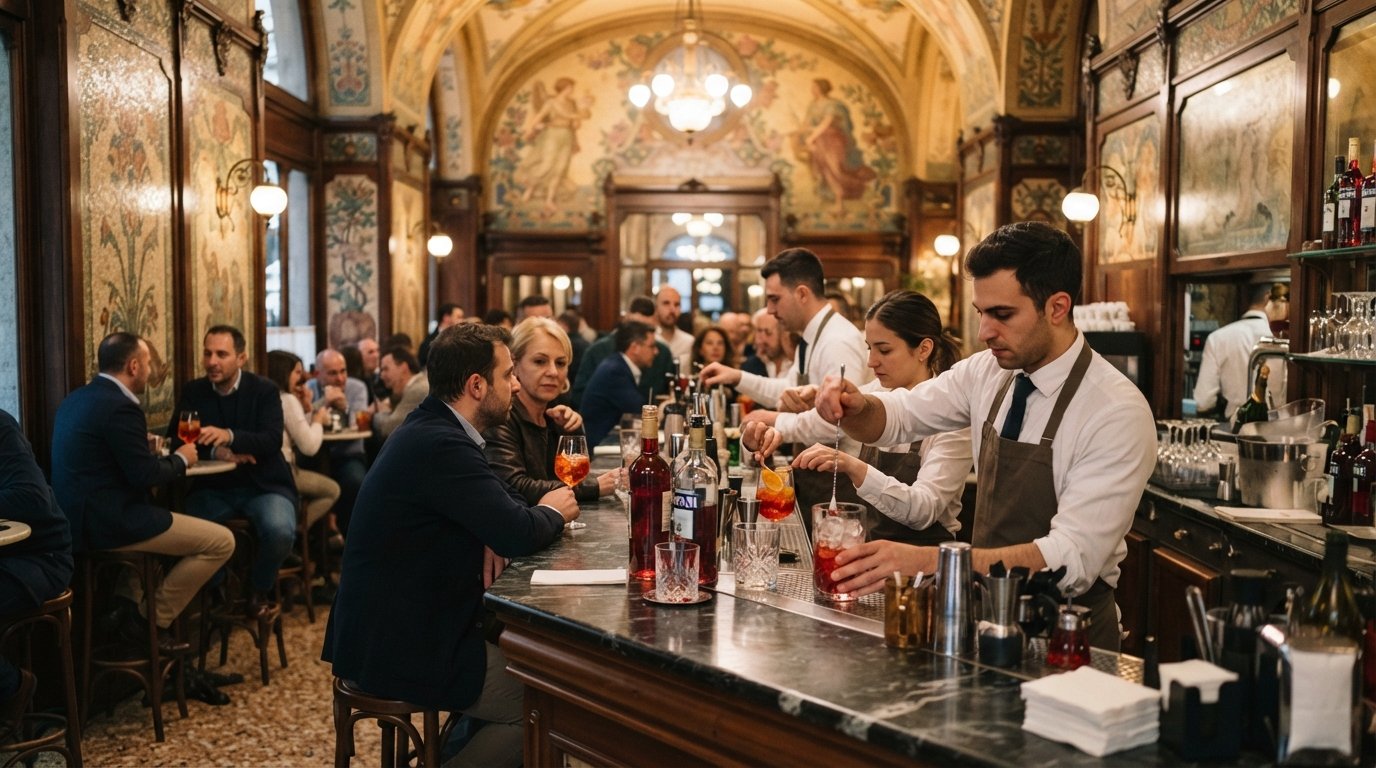
Evenings here are not for wildness. The serious nightlife is elsewhere, in Navigli or Porta Venezia, where the city loosens its tie. In the Centro Storico, the night is about aperitivo, light, and the pleasure of sitting still while the square keeps moving. The essential stop is Camparino in Galleria, opened in 1915 by Davide Campari at the mouth of the arcade and restored with its Art Nouveau mosaics and frescoes after a long and rather Milanese sequence of changes of hands. This is the birthplace of the Campari-soda ritual, and it still behaves like a place that knows the value of a proper bitter. Order a Negroni or a Campari and soda, accept the premium for the address, and watch the bartenders work.
For the postcard view, Terrazza Aperol sits on an upper floor at the corner of the piazza, reached through the Autogrill Duomo store, with a direct, face-on view of the cathedral. It opens from late morning to late, and the drinks arrive with focaccia and olives, which is the sort of practical generosity one appreciates after a day of cathedral steps. Terrazza Duomo 21 is the more refined rooftop option, a lounge-bar-restaurant with front-row terrace views over the spires. All three fill fast at golden hour. Milan does not pretend otherwise.
Things to do / what to see
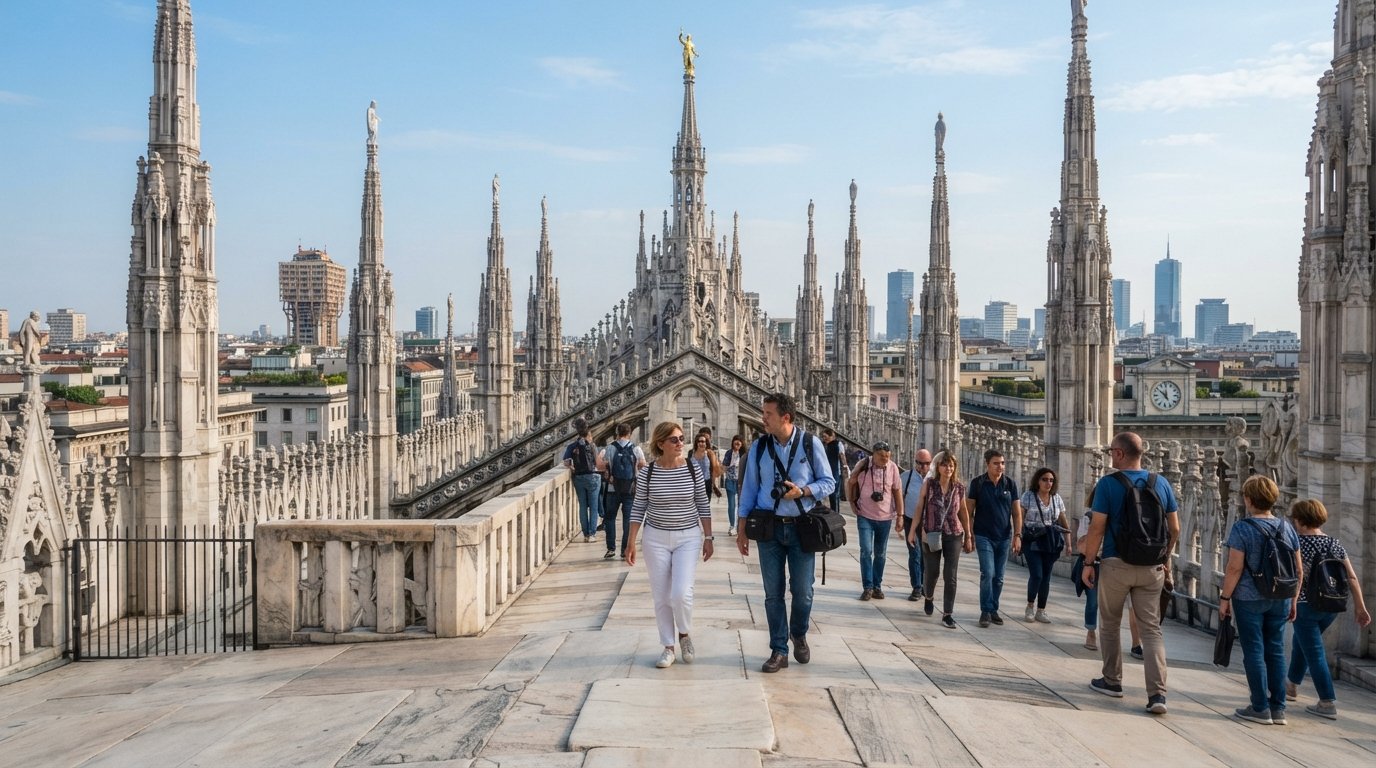
Start with the Duomo rooftop terraces. There is no sensible argument against it. You walk out among the marble spires and flying buttresses with the city spread below, and the whole quarter suddenly makes architectural sense. Tickets run about €16 by stairs or €18 by lift, with combined cathedral-plus-terraces tickets around €22–€26, and the terraces are open roughly from 9am to 7pm. Go early or late if you can. The queues are better behaved, and the light is kinder. Inside, the cathedral and its museum are worth the combined ticket too, but the roof is the place where the Duomo stops being a monument you look at and becomes a place you physically inhabit.
Next door, the Museo del Novecento in the Arengario building gives the city a clean, elegant counterpoint to all that Gothic stone. Its collection of 20th-century Italian art — Boccioni, Modigliani, Morandi, de Chirico — costs about €10, or €5 reduced, and the upper windows frame the Duomo beautifully. It is one of the best places in Milan to understand how the city likes to place the old and the modern in conversation without making a fuss about it. The building does the work quietly.
For music, Teatro alla Scala is the draw. You can tour the Museo Teatrale alla Scala, open 9:00–17:30 and around €9, or do what the city’s more devoted opera-goers do and catch a performance. The cheapest way in is the loggione, the standing gallery at the very top, at roughly €13–€15, sold on the day. It is not luxurious, but it is real, and sometimes that matters more.
Then simply walk. The Galleria Vittorio Emanuele II is not only a landmark but a route, a place to cross slowly and look up, and Piazza dei Mercanti rewards anyone willing to take one street back from the cathedral crush. In this quarter, the best sightseeing is often just the act of moving between the big names on foot, noticing how quickly the scale changes once you leave the piazza.
Don’t miss in Duomo & Centro Storico
The Duomo di Milano and its walkable rooftop terraces.
The glass-domed Galleria Vittorio Emanuele II.
Palazzo Reale, hosting major art exhibitions.
Shopping
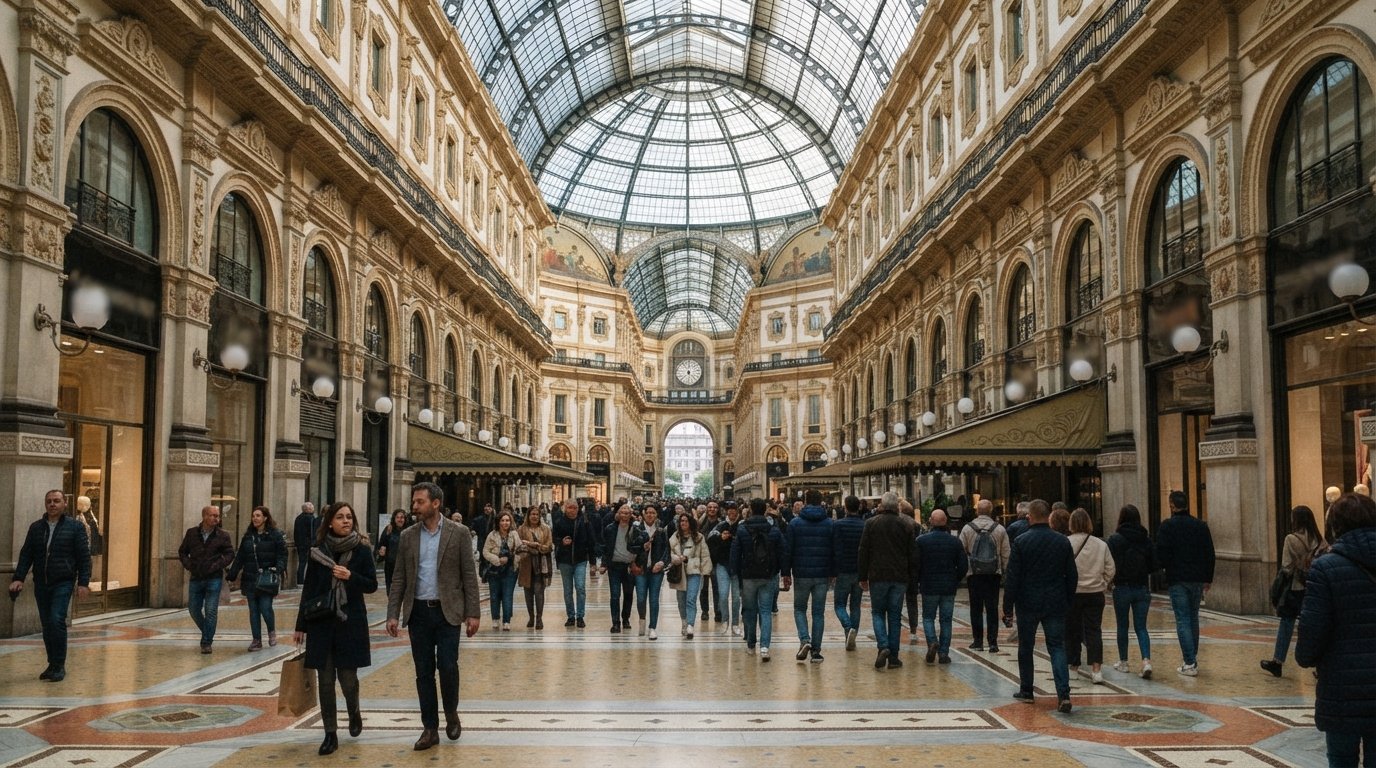
Shopping here is not an afterthought; it is part of the neighbourhood’s identity, for better and for worse. The Galleria Vittorio Emanuele II is the central story, and it is a serious one. Prada opened its first store under this glass in 1913 and still trades there, alongside Louis Vuitton, Gucci, Borsalino and Church’s. You can walk the arcade as an architectural promenade and never buy a thing, which is probably the healthiest way to approach it. It is a place where the windows are as carefully composed as the merchandise.
For food shopping, Peck on Via Spadari is the gourmet flagship, good for wine, olive oil and panettone in season, while Marchesi 1824 boxes up pastries and chocolates with the sort of restraint that makes a gift feel more expensive than it is. If you are mapping a serious shopping day, the Quadrilatero della Moda begins just a few minutes’ walk northeast, which means the Centro Storico makes a perfectly sensible launch point. There is no traditional market in the immediate cathedral zone. Milan keeps its markets for other quarters and its luxury for this one.
Where to stay in Duomo & Centro Storico
Staying here means paying the highest room rates in Milan in exchange for having the cathedral, the Galleria and the metro hub outside the door. For a first trip, or any trip built around sightseeing rather than lingering, that convenience is hard to beat. The trade-off is obvious: this is one of the busiest parts of the city, and the crowds begin early. Square-facing rooms are loud, with cleaning, delivery vans and the day’s first visitors all making their case before breakfast.
At the top end, the Park Hyatt Milano sits directly across from the Galleria, while Mandarin Oriental and Sina The Gray are both a couple of minutes from the piazza. For design-led rooms right beside the cathedral, STRAF is metres from the Duomo, and Rosa Grand is a two-minute walk on Piazza Fontana. If you want the view but a slightly calmer street, look around Via Spadari, Via Santa Margherita and towards Cordusio rather than directly onto the square. Milan does not reward people who insist on sleeping with the postcard in their window.
Hotels in Duomo & Centro Storico
Our best-rated stays in this neighbourhood. Prices are approximate “from” rates — confirmed at the provider when you continue. We may earn a commission if you book through our partners — at no extra cost to you.
In this area
In this area
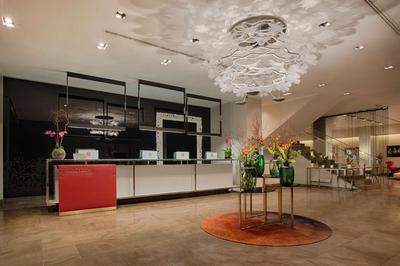
Duomo & Centro Storico
Tivoli President Milano Hotel
9.0· 3,589 reviews
approx. from£393 / nightSee prices
In this area
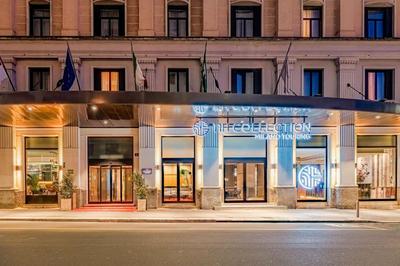
Duomo & Centro Storico
NH Collection Milano Touring
8.4· 5,403 reviews
approx. from£224 / nightSee prices
In this area
In this area
In this area
In this area
In this area
In this area
In this area
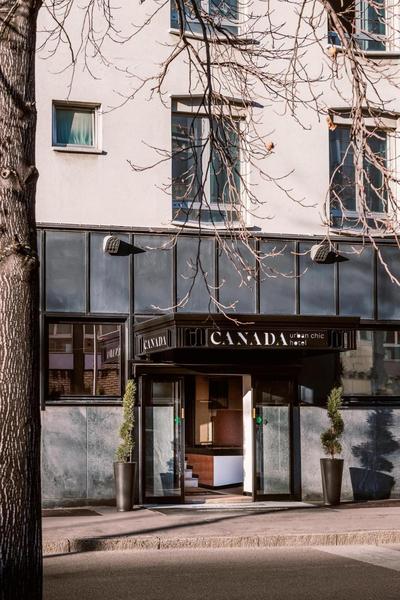
In this area
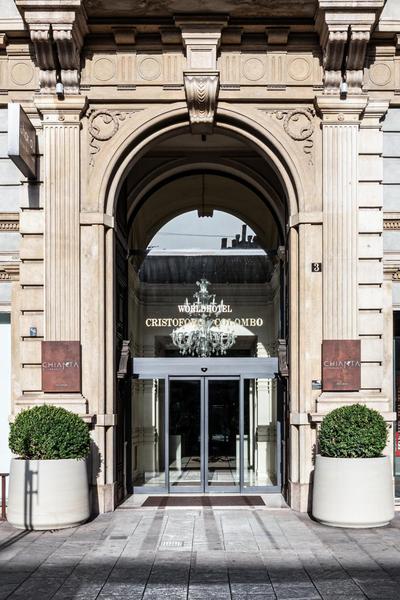
Duomo & Centro Storico
Hotel Cristoforo Colombo Member of Preferred Hotels & Resorts
8.6· 5,368 reviews
approx. from£270 / nightSee prices
Getting around
You will walk most of this neighbourhood. Duomo to the Galleria to La Scala is a few flat minutes on foot, and that is part of the pleasure. The Duomo metro station sits directly under the piazza and is served by the M1 red and M3 yellow lines, which means you are one change or fewer from almost anywhere in the city. Trams and buses ring the square too, though once you are here, you will probably prefer to keep moving at street level.
The metro runs roughly from 6am to 12:30am. For Linate, the closest airport, take the M4 blue line, which links to San Babila, a short walk or one M1 stop from Duomo. For Malpensa, the best route is the Malpensa Express from Milano Cadorna or Centrale, both a couple of metro stops away. Milano Centrale is a straight ride north on the M3 yellow line. In other words: this is the city’s most obvious starting point, and also one of its easiest to escape from when you have had enough marble for the day.
Gallery
Duomo & Centro Storico in pictures
Duomo & Centro Storico — your questions
Is Duomo & Centro Storico a good area to stay in Milan?
Yes, especially for a first or short trip. It is the most central, best-connected part of the city, with the cathedral, Galleria and metro on the doorstep. The trade-offs are high room rates and constant crowds, so light sleepers should avoid piazza-facing rooms and look instead at quieter side streets like Via Spadari or the Cordusio blocks.
Is the Duomo rooftop worth it, and how do I get up?
Absolutely. It is the highlight of the area, with marble spires, the city below and, on clear days, the Alps. Buy tickets online in advance: about €16 by stairs or €18 by lift, with combined cathedral-and-terraces tickets around €22–€26. Go early morning or near closing to avoid the worst queues and heat.
Where can I get a Duomo view with a drink?
Terrazza Aperol on the piazza corner has a direct, face-on cathedral view; Terrazza Duomo 21 is the more refined rooftop option; and Giacomo Arengario’s terrace at the Museo del Novecento frames the spires for a meal. All fill quickly at sunset, so arrive early or reserve.
What should I eat first in the Centro Storico?
Start with Luini’s panzerotti on Via Santa Radegonda for a quick, cheap lunch, then bookend the day with Trattoria Milanese for classic risotto alla Milanese, ossobuco and cotoletta, or Peck if you want a more polished food-hall stop.